


Rewiring the Critic Within: How Negative Self-Talk Sabotages Life Transitions (and How to Fix It)
We all live with an internal narrator. From the moment we wake up, a quiet running commentary evaluates our choices, judges our performances, and dictates how we feel about ourselves. When life is smooth, that inner voice might remain fairly neutral. But when you are standing on the precipice of a major life transition—whether shifting careers, navigating relationship changes, processing grief, or stepping into a new era of adulthood—that narrator can quickly turn adversarial.
You might hear subtle phrases floating through your mind: "I don't know what I'm doing," "It's too late for me," or simply, "I'm stupid."
While these phrases feel like harmless fleeting thoughts, they quietly dictate your mood, shape your behavior, and create invisible boundaries around your life. Healing and personal growth require more than just passive listening; true change happens when you are deeply heard and equipped to challenge the internal blocks holding you back from your full potential.
The Hidden Weight of Internal Dialogue During Life Transitions
When adults navigate significant milestones, resistance is a natural psychological defense mechanism. Transition forces us to leave behind familiar roles and step into the unknown. If you are grieving a past season or feeling anxious about what comes next, your mind often defaults to negative self-talk as a way to protect you from potential failure.

Why the Brain Resists the "Next Phase"
From a clinical perspective, negative self-talk is rarely about current reality; it is often rooted in old coping mechanisms, past trauma, or unexamined beliefs. In Cognitive Behavioral Therapy (CBT), we look at how underlying assumptions directly influence our daily emotional states:
- Emotional Contagion: Calling yourself "dumb" or "incapable" triggers real emotional responses—shame, heavy mood, and low energy—before you even have a chance to evaluate the situation objectively.
- Behavioral Avoidance: When your mood drops, your behavior follows. You hesitate to take the next step, pull back from intimate connections, or delay making decisions that serve your future self.
- Unfinished Business: Drawing from Gestalt therapy and grief work concepts, unexpressed sadness or past trauma can manifest as current self-criticism, keeping you tethered to older, safety-focused versions of yourself.
Navigating life stages as an adult or couple often means redefining success on your own terms, which makes developing a compassionate internal dialogue essential for finding acceptance and an ability to navigate your next phase of life.
Treating Cognitive Reframing Like a "Mental Gym"
In my short video above, I draw a direct comparison between building physical strength and reframing negative self-talk: it is just like going to the gym on day one.
The first time you walk up to a heavy weight or start a new fitness routine, it feels uncomfortable, awkward, and demanding. Your muscles resist. Replacing deeply ingrained neural pathways works the exact same way. You cannot expect a lifetime of negative self-criticism to vanish overnight, but consistent practice builds profound cognitive flexibility over time.

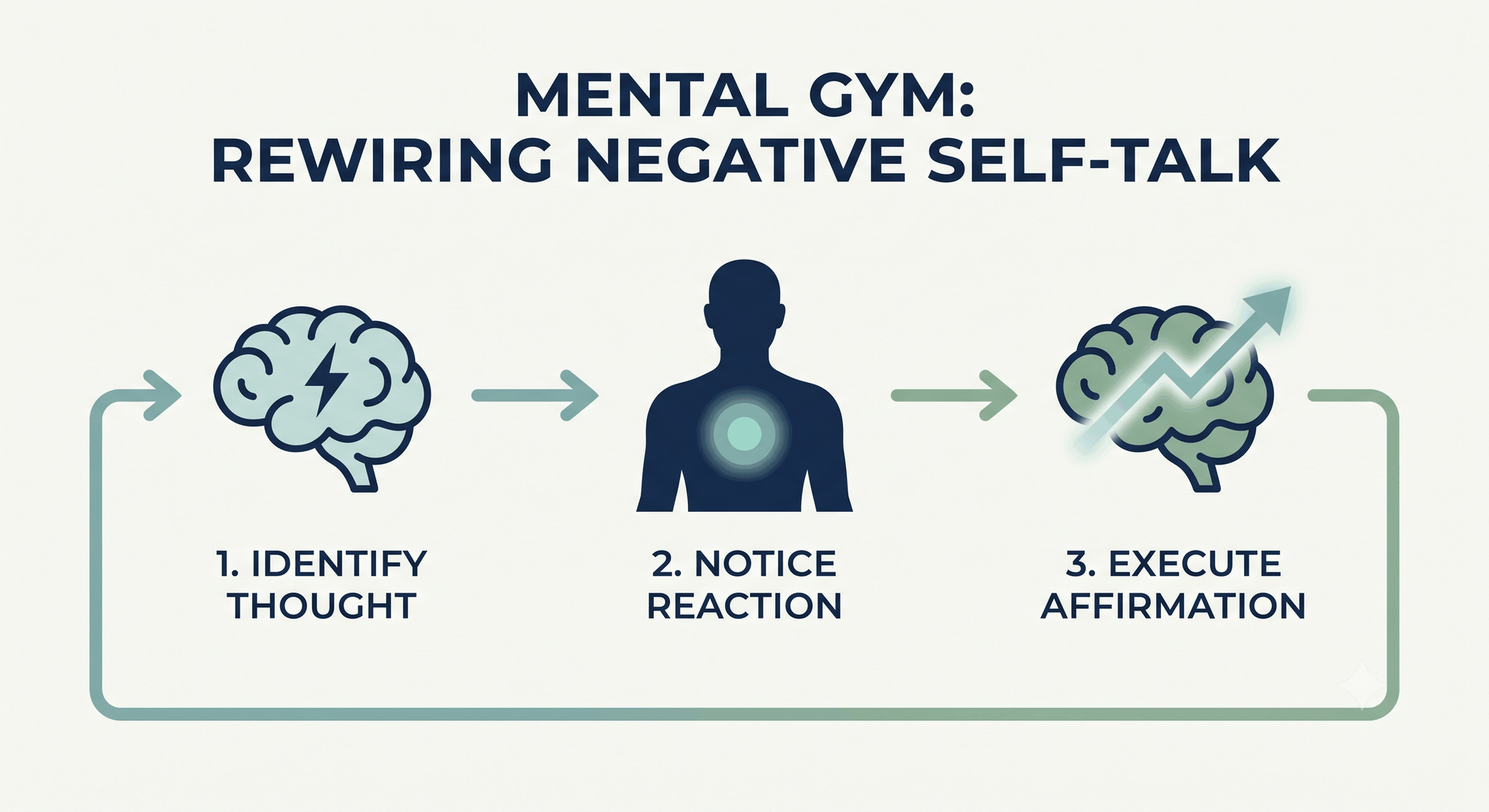
3 Steps to Reprogram Your Internal Dialogue
To shift your mental environment from criticism to encouragement, practice these three structured clinical steps whenever you catch a negative thought rising:
- Identify and Label the Automatic Thought:
Catch the phrase as it occurs. Instead of accepting "I don't know what I'm doing" as absolute truth, name it as an automatic cognitive distortion. Recognizing the thought creates immediate psychological distance between you and the narrative.
- Notice the Emotional and Physical Response:
Pay attention to where that thought sits in your body. Does your chest tighten? Does your mood dip? Gestalt and Dialectical Behavior Therapy (DBT) principles emphasize staying present with your bodily sensations to process resistance rather than running from it.
- Execute the "Affirmation Rep": Immediately replace the negative statement with a grounded, realistic affirmation. Swap "I can't handle this transition" with "I am capable, wise, and learning as I step into this next phase." Repeat this daily until the positive pathway becomes your default response.
The Role of Talk Therapy in Reaching Your Full Potential
Self-help tools and affirmations are powerful starting points, but breaking through deep-seated internal dialogue often requires a dedicated clinical space. Why talk therapy? Because healing is not just about listening—it is about being heard and addressing what holds you back. Talk therapy offers a structured, compassionate environment where you can explore the root causes of those negative narratives.

Whether you are working through complex grief, navigating a life pivot, or strengthening your primary relationship, working with an experienced therapist helps you:
- Uncover trauma-informed patterns that keep you feeling stuck.
- Develop customized CBT, DBT, and Gestalt strategies tailored to your unique lifestyle and goals.
- Build authentic self-acceptance so you can reach your full potential in all areas of your life.
Navigating Life Transitions with Telehealth Psychotherapy
Stepping into your next phase of life shouldn't mean doing it alone. My practice is dedicated to helping motivated private-pay adults and couples overcome internal resistance, process grief, and achieve their full potential. Providing 100% telehealth psychotherapy across California and Louisiana, I offer compassionate, open, and connected care designed around your busy life—helping you build acceptance and navigate your next chapter with clarity and confidence.
Frequently Asked Questions
Why talk therapy for negative self-talk?
Talk therapy provides an objective, professional space where you can bring automatic thoughts into the open. Healing is not just about listening; it is about feeling deeply heard and actively addressing what holds you back. An experienced therapist helps you pinpoint the root causes of self-criticism and provides evidence-based tools (like CBT and DBT) to systematically replace them with healthier cognitive patterns.
How does telehealth psychotherapy work for life transitions?
Telehealth offers high-quality, private, and convenient care directly from your home or office. Through secure video sessions, adults and couples across California and Louisiana can engage in meaningful, goal-oriented therapy without the added stress of commuting, making it easier to integrate mental wellness into times of change.
How can CBT and Gestalt therapy help with life transitions?
Cognitive Behavioral Therapy (CBT) helps identify and reframe the negative beliefs and self-doubt that often surface during major life shifts. Combined with Gestalt and trauma-informed techniques, therapy helps you process lingering grief or resistance, allowing you to build self-acceptance and confidently navigate your next phase of life.
Who is a good fit for private-pay telehealth therapy?
My practice is ideal for private-pay adults and couples who are highly motivated to do the work. If you are experiencing difficulty transitioning from one stage of life to the next, working through grief, or looking to break free from self-limiting beliefs to reach your full potential, telehealth psychotherapy provides dedicated, tailored care focused entirely on your goals.
You don't have to navigate this alone.
I provide a safe space for adults and couples motivated to do the work.